
Buyers comparing “AI decisioning” products often ask which vendor wins. That question is usually the wrong one. The market splits by what a vendor already owns: a channel and a send button, a warehouse and first-party tables, an experiment SDK inside a product surface, or a headless policy API. Fit follows starting point. Algorithm slogans do not.
This post is a map for that choice. It covers BrazeAI Decisioning Studio (OfferFit), MoEngage after Aampe, Hightouch AI Decisioning, common experimentation platforms, the retirement of Azure Personalizer, and where BanditBuzz sits today, including gaps that still matter. Figures from vendor press are labeled as vendor-stated. Deal terms that appear in SEC filings are labeled as such.
A short timeline of market votes
The last eighteen months put clear prices on decisioning infrastructure.
| Date | Event | What it signals |
|---|---|---|
| Mar 27, 2025 | Braze announces an agreement to buy OfferFit for $325 million, subject to customary closing adjustments | Engagement platforms will pay cash and stock to own the decision layer |
| Jun 2, 2025 | Braze completes the OfferFit acquisition | OfferFit becomes BrazeAI Decisioning Studio inside Braze’s engagement stack |
| May 2025 | Datadog acquires Eppo | Experimentation folds into observability and product analytics |
| Sep 2, 2025 | OpenAI agrees to acquire Statsig | Experimentation also folds into an applications platform |
| Apr 29, 2026 | Hightouch raises $150M at a $2.75B valuation with AI Decisioning as a flagship | Warehouse-native activation keeps funding decisioning as a product line |
| Jun 23, 2026 | MoEngage announces acquisition of Aampe | Another engagement platform absorbs an independent decisioning company |
| Oct 1, 2026 | Azure Personalizer retires | Headless Rank/Reward without owned context and attribution does not survive as a cloud product |
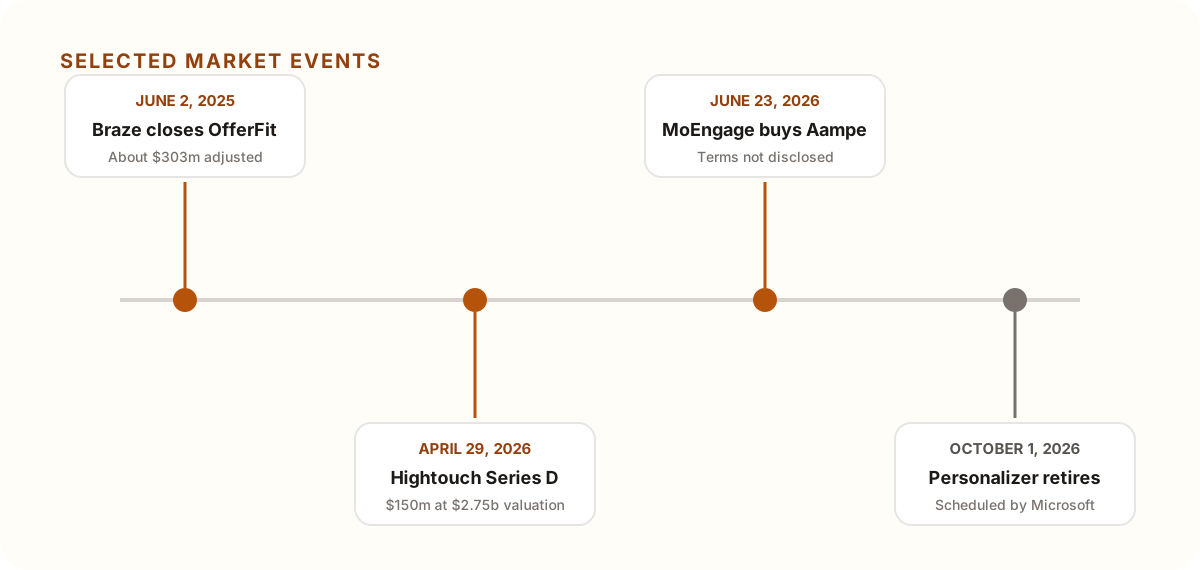
Selected market events. Sources: Braze and SEC, Hightouch, MoEngage, and Microsoft.
The pattern is consistent: independent decisioning companies have tended to land inside platforms that already own marketers, warehouses, or developer workflows. That is not a verdict against decisioning. It is a reminder that distribution and data plumbing decide who gets to keep the loop.
Four starting points
Before feature lists, ask what you already have and what you refuse to rebuild.
- Channel-first. You already live in an engagement platform. Content, consent, journeys, and send sit there. Decisioning is valuable if it chooses among approved sends without forcing a second stack.
- Warehouse-first. Your customer truth lives in Snowflake, BigQuery, Databricks, or similar. Data teams can model audiences and events. Decisioning is valuable if it reads that truth and writes picks back into tools you already pay for.
- Product-experiment-first. Your team already ships feature flags and A/B tests with a two-line SDK. Decisioning is valuable if it personalizes UI or product paths on session metrics you already trust.
- API-first. You want a small decision surface that returns a choice and accepts a later business result, including results that arrive on a different identifier days later. You keep content and execution elsewhere.
BanditBuzz is built for the fourth starting point, with optional push delivery into owned destinations. Other starting points often fit other products better. The rest of this post says when.
Channel-native decisioning: Braze and MoEngage
BrazeAI Decisioning Studio (OfferFit)
Braze’s public agreement priced OfferFit at $325 million, subject to closing adjustments. After close, Braze’s SEC disclosure for the OfferFit business combination reports total adjusted purchase price consideration of about $303.2 million ($195.6 million cash and $107.6 million in Class A common stock). The announced headline and the final adjusted consideration are both real; they answer different questions.
Product naming has moved from OfferFit to BrazeAI Decisioning Studio. Braze describes it as a reinforcement-learning decision layer that chooses message, channel, offer, timing, and related levers for each person, activated through Braze’s engagement platform. Vendor materials also say it can work with warehouse or CDP signals. Treat those capability claims as vendor-stated unless you verify them in a live pilot.
Fit. Strong when marketers already work in Braze, content and journeys already live there, and the buyer wants decisioning as part of renewal and day-to-day send operations. The structural strength is the send button. The structural risk for some buyers is reward truth: channel exhaust (opens, clicks, in-app events) is easy to see; an in-store purchase, a billing churn, or a call-center save may still need deliberate wiring into the reward the agent optimizes.
When another product fits better. If the decisive result never appears as a Braze event, or if the same decision must span tools Braze does not execute, a channel-native agent can be the wrong unit of ownership even when its models are strong.
MoEngage and Aampe
On June 23, 2026, MoEngage announced that it acquired Aampe. Terms were not disclosed. MoEngage’s release positions Aampe as per-user agentic decisioning for content, timing, channel, and frequency, with marketers setting goals and guardrails. The same release states, as a vendor claim, that Aampe runs hundreds of millions of dedicated agents and processes more than 200 billion decisions every week. That scale figure is vendor-stated; it is not independently audited here.
Aampe’s own description in that announcement highlights Thompson sampling and multi-armed bandit methods with individual-level causal measurement. Thompson sampling itself is old and well studied; William R. Thompson’s 1933 probability-matching paper is the classic root BanditBuzz also cites for its free policy. Shared algorithm lineage does not make two products interchangeable. Ownership of channels, rewards, and identity still differs.
Fit. Strong for B2C teams already standardized on MoEngage, or for teams that want Aampe’s agent model while staying inside an engagement platform’s distribution. When another product fits better. Same channel-reward caution as Braze: if the business result lives outside the engagement stack, confirm the closed loop before treating native decisioning as complete.
Warehouse-native decisioning: Hightouch
Hightouch’s April 29, 2026 Series D post says the company raised $150 million at a $2.75 billion valuation, led by Goldman Sachs and Bain Capital Ventures. The post frames an agentic marketing platform on top of the company’s warehouse-centered activation business. AI Decisioning is part of that story.
Hightouch’s own AI Decisioning overview is explicit about setup order: workspace configuration, data preparation, and at least one messaging destination (docs currently highlight Braze, Iterable, or Salesforce Marketing Cloud) before marketers create agents. Prepare data for AID asks for a parent user model, related models, event models with timestamps and outcome names, and Customer Studio audiences. That is a real data project. It is also the product’s intended strength: decisions learn from warehouse-resident first-party history rather than from a thin channel profile alone.
Fit. Strong when a warehouse is already the system of record, data teams can own models and freshness, and marketers want agents that choose message, channel, and timing into connected ESPs. Hightouch is often the right answer for enterprises that already paid the warehouse tax.
When another product fits better. If there is no warehouse project yet, or if the first value must arrive before schema mapping and destination setup, warehouse-first onboarding is a cost, not a feature. BanditBuzz’s wager is that some teams start below that line with two API calls and add history later. That is a segment claim, not a claim that BanditBuzz beats Hightouch at warehouse-native depth.
Experimentation platforms: close cousins, different loop
Eppo, Statsig, Optimizely, GrowthBook, and similar tools sell developers assignment, analysis, and often multi-armed bandits as features of product experimentation. Datadog’s Eppo acquisition and OpenAI’s Statsig agreement show how valuable that developer motion is to larger platforms. Press reporting around Statsig has cited a roughly $1.1 billion all-stock deal; OpenAI’s own post emphasizes leadership and continued independent operation of Statsig for customers, subject to closing conditions.
These products are excellent when the unit of work is a UI or product experience keyed by a stable user id, and when the reward is a product-analytics event in the same session world. They are a weaker fit when the unit is a lifecycle marketing person, the reward is a purchase that arrives days later under another identifier, and the action must leave through an ESP or warehouse pick list.
Bandits in an experiment SDK and bandits in a customer decisioning loop can share theory. Li, Chu, Langford, and Schapire (2010) showed on Yahoo Front Page traffic that adding user features lifted clicks 12.5% over a context-free bandit, with a larger advantage when data was sparse. That result supports testing contextual policies. It does not mean an experiment platform automatically owns delayed, cross-identifier marketing rewards.
Fit. Product and growth engineering teams optimizing in-product experiences. When another product fits better. Lifecycle decisions whose proof depends on business events and identity joins outside the experiment subject key.
The cautionary tale: Azure Personalizer
Azure Personalizer was the closest widely shipped cloud product to a headless Rank and Reward API. Microsoft’s lifecycle page lists retirement on October 1, 2026. Microsoft’s Personalizer overview also notes that new resources stopped on September 20, 2023, and recommends migrating to the open-source microsoft/learning-loop.
Personalizer asked clients to bring context features, wire rewards, and own attribution. That is algorithm-as-a-service. For many marketing loops, the hard part is not Thompson sampling or a linear contextual policy. The hard part is joining a decide call to a later business result when identifiers differ, and having enough person context without a multi-month data program. A headless service that leaves those problems entirely to the client is easy to admire and hard to keep alive as a product.
Teams still on Personalizer have a deadline, not a recommendation to buy any particular replacement. The useful lesson is product shape: decisioning that only ships the learner tends to lose to systems that also ship the loop.
Where BanditBuzz sits
BanditBuzz is a young decision layer with a narrow surface: POST /decide, POST /events, optional feedback, a scoreboard, and one declaration that turns a decision point into a push loop with eligibility, cooldown, timing limits, and a destination. Content generation and journey building are out of scope. Execution stays in your tools. See the product overview and implementer path.
What it tries to own:
- Two-call start. A decision point can begin on the first decide call. Client data is a deepener, not a gate.
- Business-event rewards. Purchases, renewals, and similar results can arrive later, including under identifiers that differ from the decide call, with nightly attribution after identity resolution.
- Automatic holdout and a lift scoreboard. Proof is against a stable control, not against last year’s campaign calendar alone.
- Fixed policies by tier. Free: Beta-Bernoulli Thompson sampling. Paid contextual: hierarchical linear Thompson sampling with a guarded doubly robust preview (Dudík, Langford, and Li, 2011). The preview reports evidence and overlap checks; checkout does not yet require a positive lower bound.
What it does not own today, and where other products often fit better:
- No paid-media connector. Scheduled picks currently go to destinations such as Klaviyo, BigQuery, Snowflake, S3, or CSV. Meta and Google Ads are not in the connector set.
- Fixed algorithms. There are no traffic floors, ceilings, or pinned options. Action learning keeps full history; only timing uses a 90-day window. There is no automatic drift response yet (Fiandri, Metelli, and Trovò, 2024 is on the research list for that problem).
- Young-product operations gaps. BanditBuzz has not published load-tested latency percentiles, an uptime SLA, rate limits, or a tested maximum option count. Fine-grained roles, scoped API keys, a buyer-visible change audit log, and a full decision/propensity/context/reward export are not available yet. Public commitments for data residency, retention and deletion, subprocessors, a DPA, and SOC 2 are still open. Do not put checkout or login behind
/decidewithout a local default and a client deadline.
If you need enterprise engagement orchestration, Braze or MoEngage may fit better. If you need warehouse-governed audiences and agents as the center of marketing ops, Hightouch may fit better. If you need in-product experiment infrastructure, an experimentation platform may fit better. BanditBuzz is for teams that want a small decide/record loop, business rewards, and identity-tolerant attribution, and that accept a young product’s missing enterprise packaging.
Compare dimensions, not slogans
Use this checklist against any vendor, including BanditBuzz. It is a fit grid, not a ranking.
| Dimension | Question to ask |
|---|---|
| Setup | What must exist before the first useful decision: warehouse models, campaign migration, SDK install, or an API key? |
| Context | Where do person features come from on day one, and what must be connected later? |
| Reward truth | Does the system optimize the business event you care about, or only channel engagement? |
| Identity | Can decide and reward use different identifiers and still join? |
| Execution | Who sends or shows the experience, and does the decision product need to own that path? |
| Control | Who sets approved actions, eligibility, frequency, legal limits, and “do nothing”? |
| Proof | Is lift measured against a stable holdout (or equivalent), and can you read uncertainty without waiting for a fixed calendar end? |
Honest answers to those seven questions usually pick the product. Feature matrices that ignore starting point usually do not.
Choosing without a winner speech
The market has priced decisioning as real infrastructure. Braze’s OfferFit deal, MoEngage’s Aampe deal, Hightouch’s Series D, and the absorption of experiment platforms into Datadog and OpenAI all say the category matters. Azure Personalizer’s retirement says algorithm hosting alone is not enough.
Pick the system that matches the loop you can actually close. If you already own the send button and the marketer workflow, channel-native decisioning is often the rational buy. If you already own the warehouse and the data team, warehouse-native decisioning is often the rational buy. If you already own product experiments, keep decisioning inside that motion for UI work. If you need a small API that learns from business events across identifiers, and you can tolerate a young product’s gaps, BanditBuzz is built for that starting point.
The useful comparison is never “who has AI.” It is which starting point you have, which reward you can prove, and which parts of the stack you refuse to replace.